Wheels, Wrenches, and Wi-Fi: The Makers Who Packed Up Their Workshops and Hit the Road
The Workshop Left the Building
For most of maker culture's history, the workshop was sacred ground. Fixed shelving, a dedicated power strip, that one pegboard you spent three weekends organizing — the physical permanence of a maker's space was almost a badge of honor. But something's shifting. More and more builders, educators, and community organizers are loading their tools into trailers, minivans, and retrofitted school buses and taking the whole operation on the road.
This isn't just a quirky lifestyle choice. It's a response to a real access problem. Makerspaces cluster in cities, near universities, or in neighborhoods with the disposable income to sustain membership fees. Rural towns, under-resourced schools, and communities without a dedicated "maker scene" often get left out entirely. Mobile making setups are one answer to that gap — and the people building them are figuring out the hard way what actually works when your workshop has to fit through a cargo door.
What Survives the Commute
Not every tool is built for a life in motion. Ask anyone who's tried to transport a laser cutter on a bumpy two-lane highway and they'll give you a very specific look.
Jamila Torres, a maker educator based out of Albuquerque who runs a traveling STEM workshop she calls "The Build Bus," learned this the hard way in her first year. "I started with the same gear I had in my classroom," she says. "A desktop CNC router, a full-size 3D printer, a soldering station with a dozen tip types. Half of it didn't survive the first month."
What she's landed on after two years of road-testing: compact, durable, and modular wins every time. Her current kit centers around a Bambu Lab A1 Mini for 3D printing (it handles vibration better than most), a Cricut for vinyl and light material cutting, a portable oscilloscope, and a rolling cart of electronics components organized in labeled tackle boxes. For power, she runs a 2,000-watt inverter generator that she can fire up in parking lots when a venue doesn't have adequate outlets.
"The goal isn't to replicate a full makerspace," Jamila says. "It's to give people a real hands-on experience they wouldn't otherwise get. You don't need a $40,000 laser cutter for that."
That philosophy — lean, purposeful, mission-driven — runs through most successful mobile maker operations. The makers who struggle are usually the ones who try to bring everything instead of asking what's actually essential.
The Van Life of Maker Culture
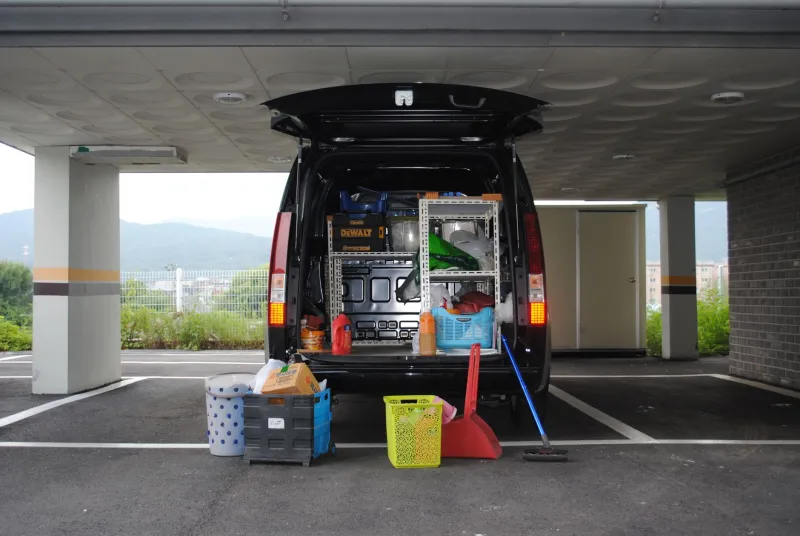
Derek Okafor runs a nonprofit called Circuit Roads out of Detroit that deploys two retrofitted cargo vans to schools and community centers across Michigan. Each van is outfitted with fold-down workbenches, magnetic tool strips mounted to the interior walls, a dedicated electrical panel, and enough supplies for workshops of up to twenty students at a time.
"We spent six months designing the interior before we ever drove it anywhere," Derek explains. "The build-out cost about $18,000 per van, which sounds like a lot until you realize we're reaching kids who have zero access to this stuff otherwise."
Funding is the persistent headache for operations like his. Circuit Roads patches together a mix of state education grants, corporate sponsorships from regional tech companies, and individual donors. Derek is blunt about the math: "You're not making money doing this. You're finding money to keep doing this. That's a different mindset than running a maker fair booth."
For makers who want to go mobile without the nonprofit structure, the economics look different but not necessarily easier. Charging for workshops — whether to schools, libraries, corporate team-building events, or maker fairs themselves — is the most common revenue model. Day rates for facilitated maker workshops can run anywhere from $500 to $3,000 depending on the size of the group and the complexity of the project, which can sustain a solo operator but rarely more than that.
Logistics Nobody Warns You About
Beyond the gear and the funding, there's a long list of logistical realities that mobile makers tend to discover the hard way.
Storage is a constant puzzle. Tools that aren't secured properly become projectiles. Consumables — filament, vinyl sheets, solder, batteries — run out faster than you expect when you're running back-to-back sessions. Vehicle maintenance becomes a genuine line item in your budget. And if you're crossing state lines with any regularity, the patchwork of regulations around things like generators, propane (if you're using heat tools in cold climates), and commercial vehicle registration can get complicated fast.
Jamila keeps a laminated checklist on the back of her driver's seat. "Every single item in that van gets checked before I leave a venue," she says. "I left a $200 soldering iron in a school gym in Gallup once. Never again."
Insurance is another often-overlooked cost. A standard auto policy won't cover a commercial vehicle loaded with electronics and power tools being used in workshops. Specialized coverage can add $150 to $400 a month to your overhead, depending on your state and the nature of your operation.
Why It's Worth It Anyway
Ask any of the makers who've gone mobile why they keep doing it, and the answers are remarkably consistent. It's the kid in a town of 800 people who's never touched a 3D printer before. It's the community center in a food desert that suddenly has a Saturday afternoon where people are building things together. It's the look on someone's face when they make something with their hands for the first time and realize they're capable of more than they thought.
Maker fairs and fixed makerspaces do incredible work. But they can only reach the people who can get to them. Mobile setups flip that equation — and the makers who've committed to the road are proving that hands-on creativity doesn't need a permanent address to change lives.