Who's Allowed to Touch the Table Saw? The Hidden Gatekeeping Inside Maker Spaces
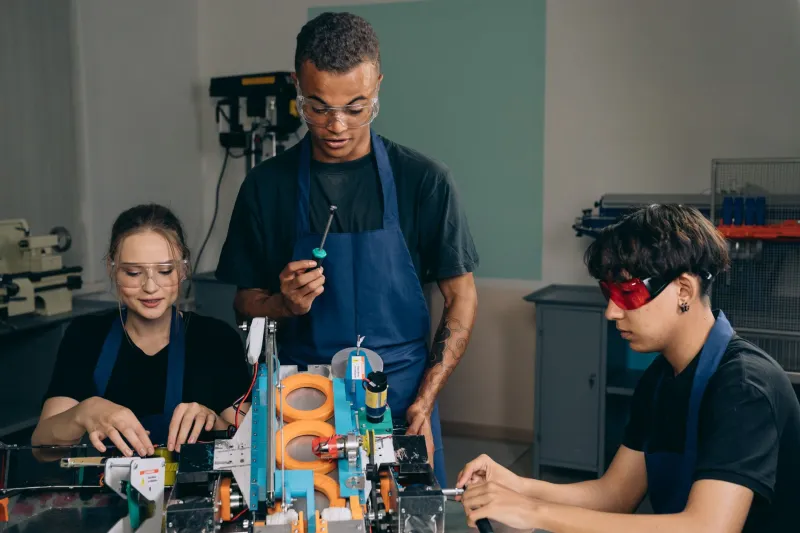
The sign on the wall says everyone is welcome. The website says the same thing, probably with a stock photo of diverse, smiling people holding circuit boards. But walk into a lot of makerspaces as a first-timer—especially if you're a woman, a person of color, someone without a technical background, or just someone who didn't grow up in a garage with a dad who owned a drill press—and the welcome can feel a lot more conditional than advertised.
This isn't always intentional. That's almost what makes it harder to fix.
The Certification Maze
Most makerspaces have safety requirements for high-risk equipment, and that's completely reasonable. A laser cutter can start a fire. A table saw can take a finger. Nobody serious is arguing against safety training. The problem is how that training gets structured, communicated, and enforced.
In many spaces, certification sessions happen infrequently, are run by volunteer members who may or may not be consistent in their instruction, and are scheduled at times that work for people with flexible daytime hours—which disproportionately excludes working parents, people with hourly jobs, and folks who commute. Miss the one Saturday session offered this month? Come back next month. Or the month after.
Keisha Odom, a 34-year-old graphic designer from Atlanta who wanted to learn laser cutting for her small business, ran into this wall at two different makerspaces before she found one that worked. "The first place, I had to attend a three-hour orientation just to get a badge that let me sign up for the actual tool training," she says. "The second place had one laser cutter class a month and it was always full. I gave up for almost a year."
That year-long gap isn't just an inconvenience. It's a dropout point. And it happens constantly.
The Informal Knowledge Test
Beyond formal certification, there's a subtler barrier that almost nobody talks about openly: the informal vibe check. Long-time makerspace members, sometimes without realizing it, respond very differently to newcomers depending on whether those newcomers signal familiarity with maker culture. Someone who walks in using the right vocabulary, who references past projects, who exudes confidence around tools—they tend to get warmth, help, and invitations to join informal project groups. Someone who walks in uncertain, who asks what might seem like basic questions, who doesn't already know the unspoken norms? They often get polite distance.
This dynamic is well-documented in other technical communities. It's sometimes called "cultural fit" gatekeeping, and it operates entirely below the level of official policy.
Marco Vidal, who runs accessibility programming at a community makerspace in Denver, has spent years trying to name this problem clearly enough that his volunteers can actually recognize it in themselves. "The hardest part is that most of our members genuinely believe they're welcoming," he says. "They're not trying to exclude anyone. But there's a real difference between being friendly to people who already fit and being actively inclusive to people who don't yet."
When Safety Becomes a Shield
Here's where things get genuinely complicated: safety requirements are sometimes used—consciously or not—as a socially acceptable reason to restrict access that's really about something else. Not everyone who invokes safety concerns is doing this, obviously. But the pattern is real enough that it's worth naming.
A makerspace that requires a $200 certification course before allowing access to any power tools isn't necessarily prioritizing safety over access. It might be, functionally, prioritizing members who can afford $200 and have the time for a multi-day course. A space that requires a member referral before you can even tour the facility isn't just being cautious. It's building a social filter.
None of this is nefarious on its face. But the cumulative effect is spaces that end up looking a lot like the exclusive clubs the maker movement was supposedly an alternative to.
What Rethinking Access Actually Looks Like
The good news is that some spaces are doing genuinely creative work on this problem, and it's worth stealing their ideas freely.
Tiered access with low-friction entry points. The Makery in Tucson restructured their onboarding so that a newcomer can walk in, take a 20-minute safety overview, and immediately access a curated set of beginner-appropriate tools—no appointment, no fee beyond the day pass. Full certification for advanced equipment is still required, but it's not the gatekeeper for your first experience.
On-demand training. Several makerspaces have moved tool certification videos online, allowing people to complete the knowledge component asynchronously and then schedule a brief in-person skills check rather than a full class. This alone dramatically expands access for people with nonstandard schedules.
Dedicated newcomer sessions with trained welcomers. Not just open houses, but structured sessions where designated members are specifically trained to make first-timers feel capable rather than behind. The difference in retention rates is significant.
Sliding-scale and subsidized memberships. Access barriers aren't only about time and knowledge. Cost is real. Spaces that offer income-based pricing consistently report more diverse membership. It's not complicated—it just requires prioritizing it.
The Safety Argument, Revisited
None of this means abandoning safety standards. It means interrogating which standards actually serve safety and which ones serve familiarity. There's a meaningful difference between "you need to demonstrate you can operate this tool without hurting yourself or others" and "you need to complete this specific course that we only offer three times a year and costs $150."
The former is a safety requirement. The latter is a process that may or may not achieve the same outcome, but definitely creates additional friction that falls hardest on people with fewer resources.
Maker culture at its best is about democratizing access to tools, skills, and the ability to build things. That mission doesn't stop at the door of the makerspace. It has to extend to who actually gets to walk through it—and what happens when they do.
The table saw doesn't care who you are. Neither should the sign-up sheet.