Wired to Build: The Hidden Brain Gains Kids Get From Making Things With Their Hands
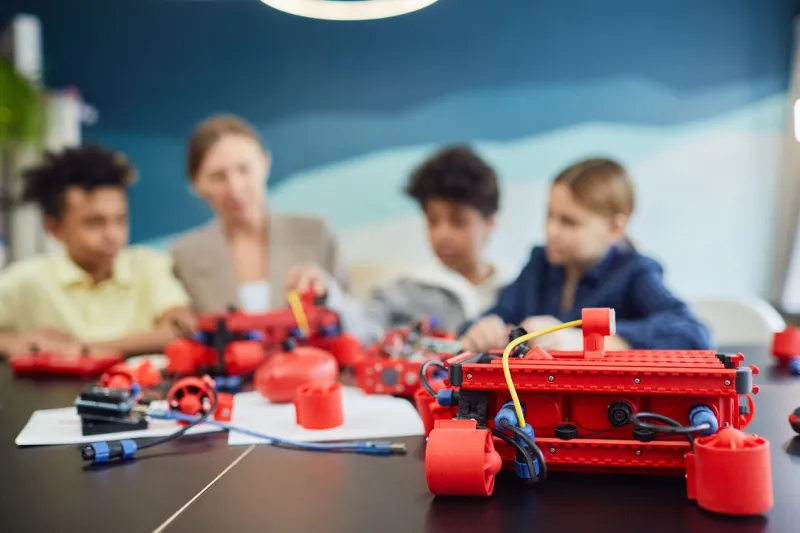
Picture a ten-year-old staring at a pile of cardboard tubes, a hot glue gun, and three AA batteries. No instructions. No YouTube tutorial cued up. Just a challenge: make something that moves. Within twenty minutes, she's built a wobbly motorized car, watched it crash into the wall, pulled it apart, and started over. She's laughing. She's frustrated. She's completely absorbed.
Now picture that same kid sitting at a desk filling in a standardized test bubble sheet.
Both moments involve learning. But only one of them is quietly rewiring her brain in ways that researchers are only beginning to fully understand.
What's Actually Happening Up There
Neuroscientists have long known that the brain develops through rich, multi-sensory experiences—and few activities pack more sensory input into a single session than hands-on making. When a child physically manipulates materials, the brain's motor cortex, prefrontal cortex, and sensory processing regions fire in coordination. That cross-talk between brain regions is the neurological equivalent of a full-body workout.
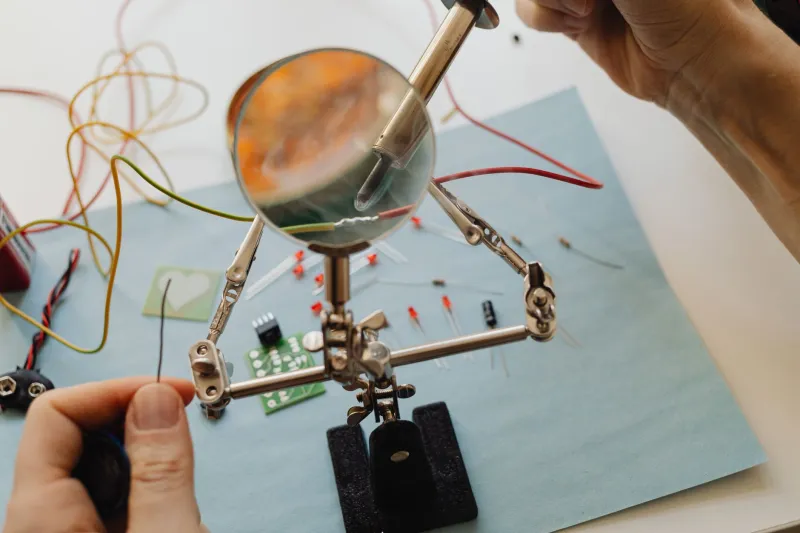
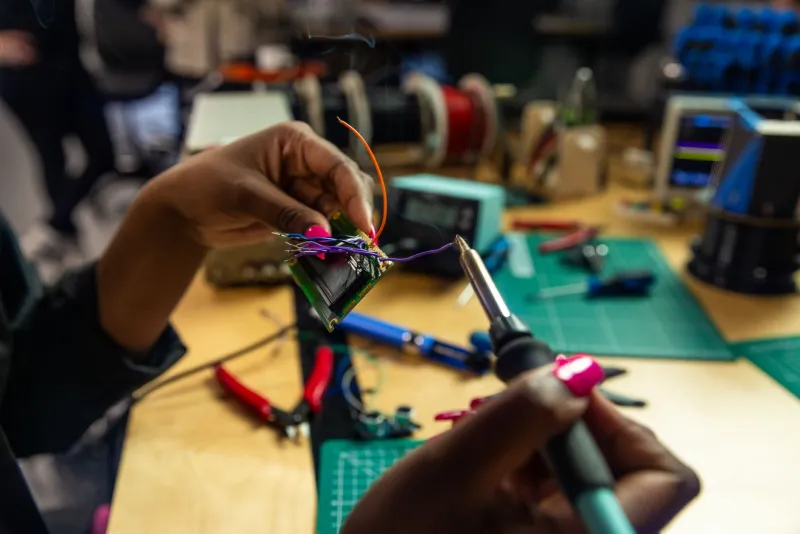
Dr. Stuart Brown, a pioneer in play research, has spent decades documenting how open-ended, object-based play strengthens the prefrontal cortex—the seat of planning, impulse control, and flexible thinking. Maker activities hit that sweet spot hard. A kid debugging a circuit isn't just fixing a wire; they're running mental simulations, forming hypotheses, and updating their model of reality when things don't go as expected. That process, repeated over hundreds of small tinkering sessions, literally shapes neural architecture.
There's also compelling work around what researchers call "embodied cognition"—the idea that thinking isn't just something that happens in your head. It happens through your hands, your posture, your physical interaction with the world. Kids who build things aren't just learning about forces and friction in the abstract. They feel the resistance. They sense when something is about to snap. Their bodies become instruments of understanding.
Failure as a Feature, Not a Bug
Here's something every maker educator will tell you: the moment a kid's project falls apart is often the most valuable moment in the whole session.
Traditional classroom settings are built around getting the right answer. Wrong answers carry social and academic consequences. Over time, many kids develop what psychologists call "failure aversion"—a deep reluctance to attempt anything they might not succeed at. It's one reason so many students disengage from STEM subjects by middle school. The risk feels too high.
Maker spaces flip that dynamic entirely. At a maker fair or a school fab lab, a collapsed bridge or a motor that won't spin isn't a bad grade—it's data. Young makers learn, almost by osmosis, that iteration is the process. You build, you test, you break, you adjust. The goal isn't perfection on the first try. The goal is figuring out why it didn't work.
This reframe has measurable psychological effects. Studies from Stanford's d.school and similar design-thinking programs show that students who regularly engage in project-based making develop significantly higher levels of what researchers call "creative confidence"—a belief in their own ability to generate ideas and act on them. That confidence transfers. Kids who feel capable of building a robot tend to feel capable of tackling other hard problems too.
The Social Layer Nobody Talks About Enough
Walk through the kids' zone at any regional maker fair in the country—say, a weekend event at a community center in Columbus or a school showcase in Albuquerque—and you'll notice something that doesn't show up in any neuroscience paper: kids are talking to each other.
Not texting. Not reacting to each other's content. Actually talking, pointing, arguing, collaborating, and sometimes very dramatically disagreeing about the best way to attach a servo motor.
Making is inherently social in a way that screen-based entertainment simply isn't. When two kids are trying to solve the same physical problem, they have to communicate clearly. They have to listen. They have to negotiate. These aren't soft skills—they're foundational human competencies that employers, educators, and therapists consistently identify as underdeveloped in the current generation of young people.
For kids who struggle in traditional social settings, maker spaces can be genuinely transformative. The project becomes a shared focus that takes the pressure off direct social interaction. Kids on the autism spectrum, kids with ADHD, kids who are shy or anxious—many of them thrive in maker environments precisely because the activity gives them something concrete to connect over. The build is the bridge.
Why This Deserves a Spot Next to Soccer Practice
American parents pour enormous resources into extracurricular activities. Youth sports alone is a $19 billion industry. Music lessons, dance classes, tutoring—families invest heavily because they understand that development happens outside the classroom too.
Maker education deserves a seat at that table.
The skills kids build through making—problem-solving, resilience, creative confidence, collaborative communication, iterative thinking—are exactly the skills that economists and workforce researchers say will matter most in the coming decades. Automation is already handling routine cognitive tasks. What machines can't easily replicate is the human capacity to look at an ambiguous problem, form a creative approach, build a prototype, and adapt when it doesn't work.
That's not a job description. That's a ten-year-old with a glue gun and a pile of cardboard.
Finding Your Kid's On-Ramp
If you're sold on the idea but not sure where to start, the good news is that entry points are everywhere. Many public libraries now host maker spaces with free drop-in hours. Community colleges often run weekend workshops for young people. And of course, maker fairs—from massive events like those inspired by the original Maker Faire concept to smaller regional gatherings—are some of the best places to let kids explore without commitment.
You don't need to enroll in a program or buy expensive equipment right away. A cardboard box, some tape, and a challenge is genuinely enough to get started. The brain doesn't care how fancy the materials are. It cares about engagement, challenge, and the satisfaction of making something real.
Start there. Watch what happens.
The science says the results might surprise you. But honestly? The look on a kid's face when something they built actually works—that tells you everything you need to know.